By Brian Firth, Editor and Tech Reporter
In about five weeks, the personal AI agent went from a niche idea to a crowded category. Meta launched Muse on September 8. OpenAI followed with Dots at DevDay on September 29. Google has been widening access to Gemini Spark since its May debut at I/O. Then two startups pushed in: Instinct, an invite-only agent you text, raised $1 billion on September 28, and Hark, the new company from Brett Adcock, released Hark Pro on October 6.
These tools do more than answer questions. They log in to your accounts, fill out forms, book appointments and pay for things. For South Florida’s small businesses, marine shops and solo operators, picking one is less about which demo is most impressive and more about what you’re willing to let it touch.
Five questions to ask before you sign up
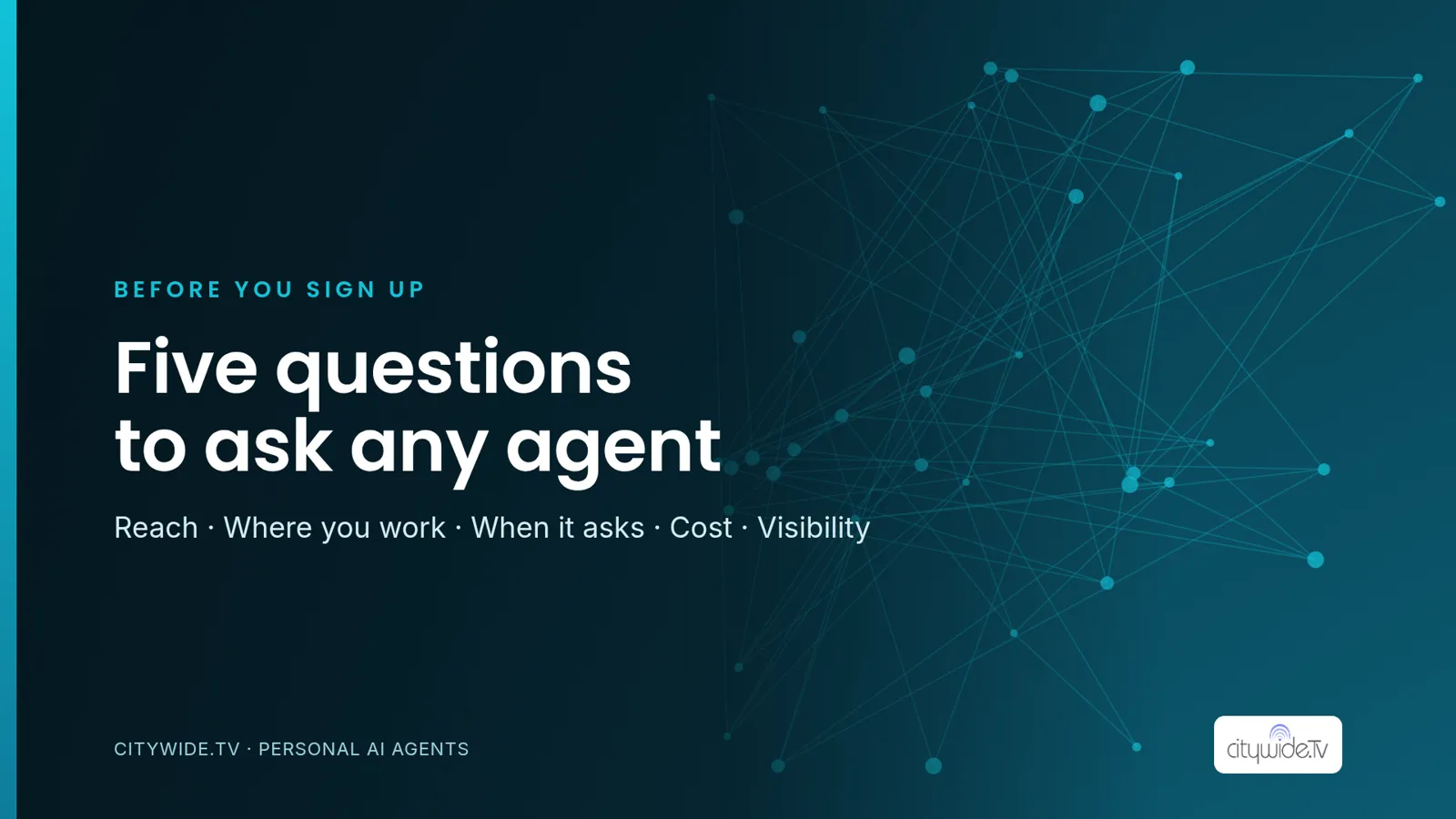
- What can it reach? Email, calendar, files, saved passwords, a credit card. Give it the least it needs.
- Where does your work already happen? An agent tied to the tools you already use will be useful sooner.
- When does it stop and ask? Look for approval rules you set yourself, not promises in a keynote.
- What does it cost, and for how long? “Free” can mean free forever, free for heavy users up to a cap, or free until the company decides otherwise.
- Can you see what it did? Look for activity logs, a way to watch it work, and a clear off switch.
Hark Pro: the newcomer that wants to get there first

Hark was founded less than a year ago by Brett Adcock, who previously founded Archer Aviation and the humanoid-robot company Figure. According to Fast Company, it has raised $700 million in Series A funding. Its first product, Hark Pro, launched October 6 on the web, iOS and Android.
Hark’s pitch is that the agent should act before you ask. The company’s launch post describes three parts: a computer-use system called Handoff, memory of your preferences, and “proactive thinking” that spots problems ahead of time. Hark says Handoff can run up to six browsers at once and log in to websites for you. It also connects to Google and Outlook through their APIs and to other tools through the open MCP standard. The home screen includes “Action Buttons” for one-tap tasks such as paying a bill or canceling a subscription, plus custom “Panels” that pull in data from connected services.
On privacy, Hark says passwords and cards live in an encrypted vault it calls Secured by Hark, which the company says even it can’t see into. It also pledges never to sell your data or share it with advertisers. In a demo for TechCrunch, Hark design lead Abidur Chowdhury, who previously worked at Apple, showed a small window that lets users watch the agent move through websites, a feature he said is meant to build trust.
Price: Hark says every feature is free. Paid plans cost $20 a month for twice the usage and $100 a month for ten times the usage.
What to watch: The product is days old. Hark’s model is trained specifically for computer use, and TechCrunch noted that it isn’t clear how much general knowledge that trades away compared with frontier models. Hark has also promised its own hardware in 2027, but nobody outside the company has seen it yet. As The Next Web points out, Hark has not said whether Hark Pro is available in Europe.
Instinct: the agent you text
Instinct, from San Francisco-based Spear Street Technology, launched invite-only in August with almost no marketing. It still became one of the most talked-about agents of the year. There’s no traditional app to sign in to. You talk to it over iMessage, WhatsApp or email, and The Verge’s hands-on describes it handling chores like booking DMV appointments and sending follow-up emails.
The money has moved fast. TechCrunch reported a Series C of $1 billion at a $10 billion valuation on September 28, with investors including Sequoia Capital, Benchmark and Coatue. That came about a month after a round that valued the company at $2.5 billion. Founder Noah Shinn is a former researcher at Sierra.
Price: Free for people who have access, through an invite from a current user or the waitlist. Instinct has no public price list, and its terms let the company add fees later. Shinn told The Verge, “Our intent is to keep it as affordable as possible.”
What to watch: Read the fine print. Under Instinct’s terms of service, your materials can be used to train AI models by default. You can opt out in settings, but the opt-out only applies going forward, and content flagged for safety review can still be used. Material you store in its “Vault” feature is excluded from training. The privacy policy itself warns of possible “unintended payments or communications,” as well as misleading instructions from third parties.
The big-lab options

- Meta Muse (launched Sept. 8, U.S.) runs on its own secured cloud computer, keeps working in the background and asks for approval before sensitive actions. It has a free tier, with paid plans reported at $20 and $100 a month.
- OpenAI Dots (launched Sept. 29) are always-on agents built on GPT-6 Astra, each with its own cloud computer and browser. You reach them through ChatGPT, Slack and Microsoft Teams. Your first Dot comes with ChatGPT Pro (from $100 a month) or Business Premium. At launch, Pro users in the EEA, Switzerland and the U.K. can’t use it.
- Google Gemini Spark (announced at I/O on May 19) works inside Gmail, Docs and Sheets. It reached U.S. Google AI Pro subscribers ($19.99 a month) in July and is not offered in the EEA, U.K., Switzerland or Nigeria.
At a glance
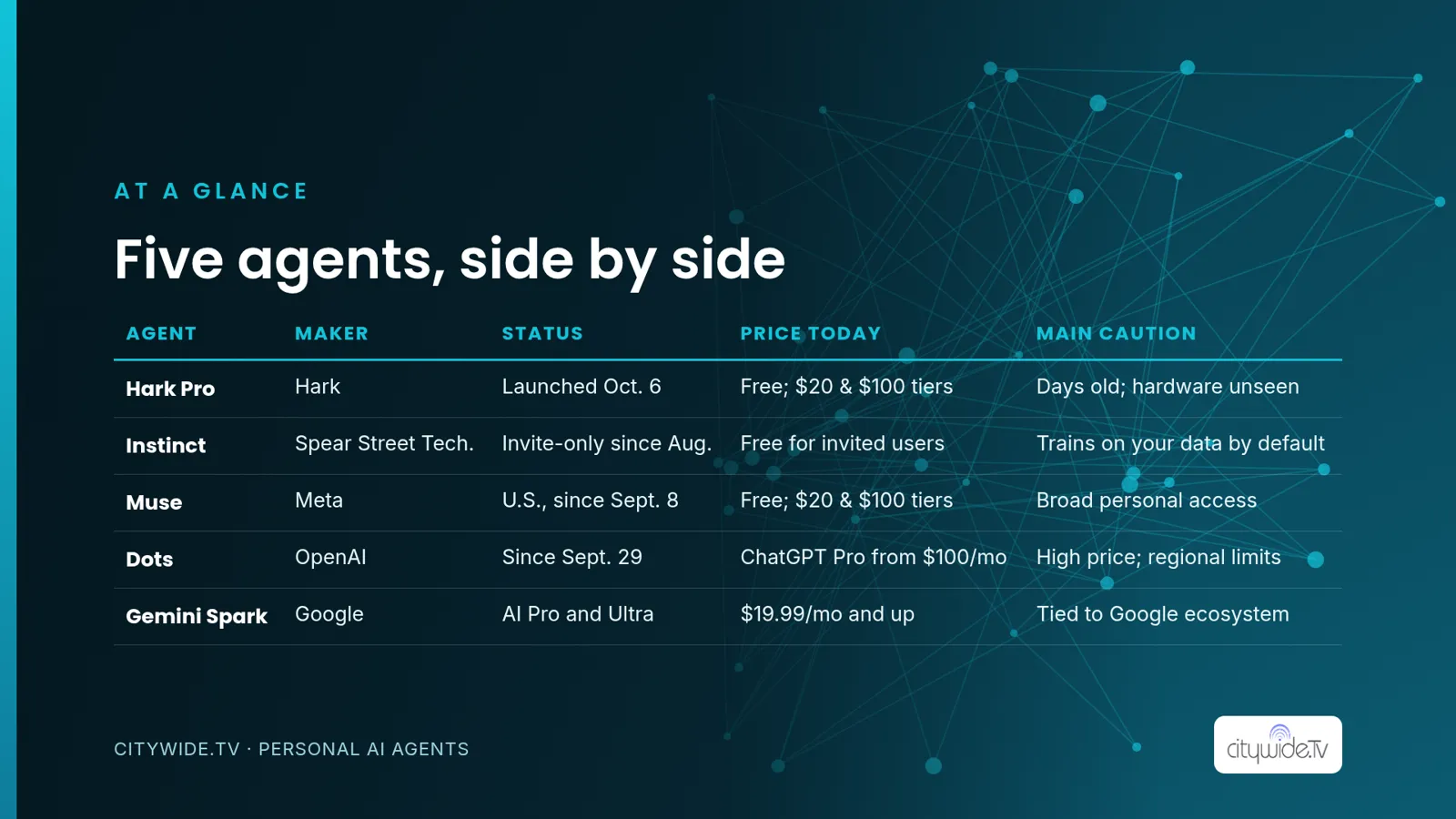
| Agent | Maker | Status | Price today | Main caution |
|---|---|---|---|---|
| Hark Pro | Hark | Launched Oct. 6 | Free; $20 and $100 usage tiers | Days old; hardware still unseen |
| Instinct | Spear Street Technology | Invite-only since August | Free for invited users | Trains on your data by default |
| Muse | Meta | U.S., since Sept. 8 | Free; $20 and $100 tiers | Asks for broad personal access |
| Dots | OpenAI | Since Sept. 29 | ChatGPT Pro from $100/mo | High entry price; regional limits |
| Gemini Spark | AI Pro and Ultra | $19.99/mo and up | Tied to the Google ecosystem |
The local takeaway

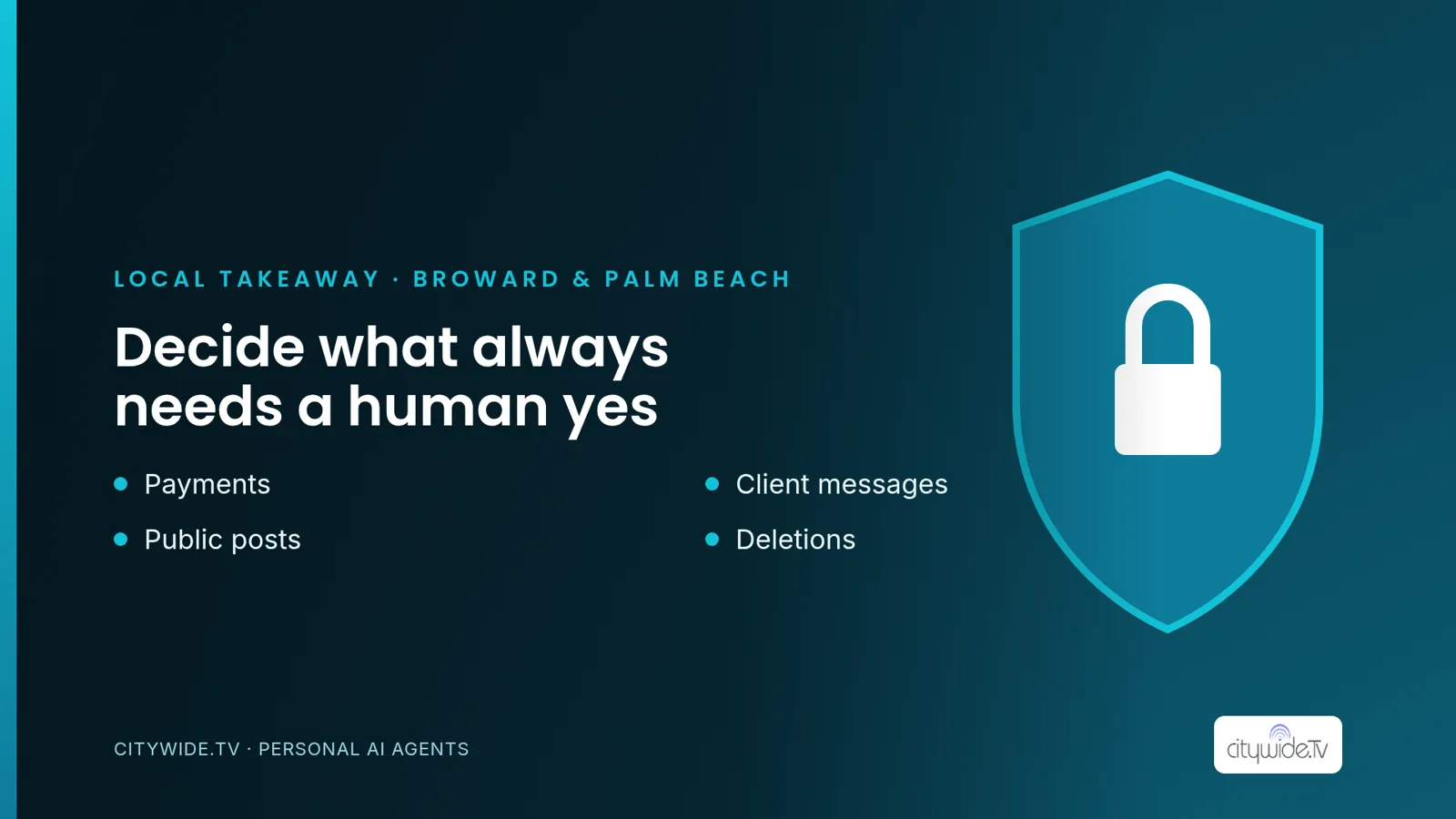
For a Broward or Palm Beach business, these products matter less as a horse race and more as a set of risk decisions. Before you connect any agent to a company account:
- Decide which actions always need a human yes: payments, client messages, public posts and deletions.
- Use a one-time or capped card, never your main business card.
- Turn off model training wherever the tool lets you.
- Start with read-only access, on separate logins you can revoke.
- Give each job to one agent, so two assistants don’t answer the same inbox.
Hark and Instinct show that startups can still compete with Meta, OpenAI and Google, at least for now. Whichever one you try, treat it like a new hire on probation. Watch what it does before you hand it the keys.
Sources (checked Oct. 10, 2026)
- Hark, “Introducing Hark Pro” (official): https://hark.com/articles/introducing-hark-pro
- TechCrunch, “Hark releases an AI personal assistant with a focus on privacy” (Oct. 6, 2026): https://techcrunch.com/2026/10/06/hark-releases-an-ai-personal-assistant-with-a-focus-on-privacy/
- Bloomberg, Hark Pro debut (Oct. 6, 2026): https://www.bloomberg.com/news/articles/2026-10-06/ai-startup-hark-debuts-proactive-hark-pro-app-ahead-of-2027-hardware-launch
- Fast Company, Hark Pro design and funding: https://www.fastcompany.com/91618831/how-hark-designed-an-ai-assistant-thats-actually-helpful
- The Next Web, Hark Pro and Europe: https://thenextweb.com/news/hark-pro-agent-hardware-europe
- TechCrunch, “Viral AI agent Instinct raises $1B Series C at a $10B valuation” (Sept. 28, 2026): https://techcrunch.com/2026/09/28/viral-ai-agent-instinct-raises-1b-series-c-at-a-10b-valuation/
- The Verge, Instinct hands-on: https://www.theverge.com/tech/1008254/instinct-agent-ai-hands-on-muse-dots
- Instinct Terms of Service (official): https://instinct.co/terms
- Instinct Privacy Policy (official): https://instinct.com/privacy-policy
- The Verge, OpenAI launches Dots: https://www.theverge.com/ai-artificial-intelligence/1002033/openai-dots-launch-muse-competitor
- The Decoder, Dots availability: https://the-decoder.com/openai-launches-always-on-dots-agents-to-rival-metas-muse/
- Tom’s Guide, Muse vs. Dots: https://www.tomsguide.com/ai/meta-muse-vs-chatgpt-dots-i-compared-the-new-ai-agents-and-theyre-not-as-similar-as-they-look
- Google, Gemini Spark release notes (official): https://support.google.com/gemini/answer/17171264?hl=en
- PCMag, Gemini Spark on AI Pro: https://uk.pcmag.com/ai/166341/googles-gemini-spark-agentic-ai-assistant-now-rolling-out-to-more-users
- Format inspiration (not copied): Zip AI, “How to Pick a Personal AI Agent”: https://zipai.io/how-to-pick-a-personal-ai-agent/