


Las Vegas — Walk the CES show floor and you’ll see glasses everywhere: on giant sculptures, on booth staff, on the faces of people queuing for demos. When Citywide.TV covered CES 2025 in January 2025, we spent time at two of the companies betting hardest on them, Rokid and XREAL. Nearly two years later, both have shipped what they showed. Here’s what we saw on the floor, what happened next, and what to watch for at CES 2027.
Rokid: AI glasses that look like glasses
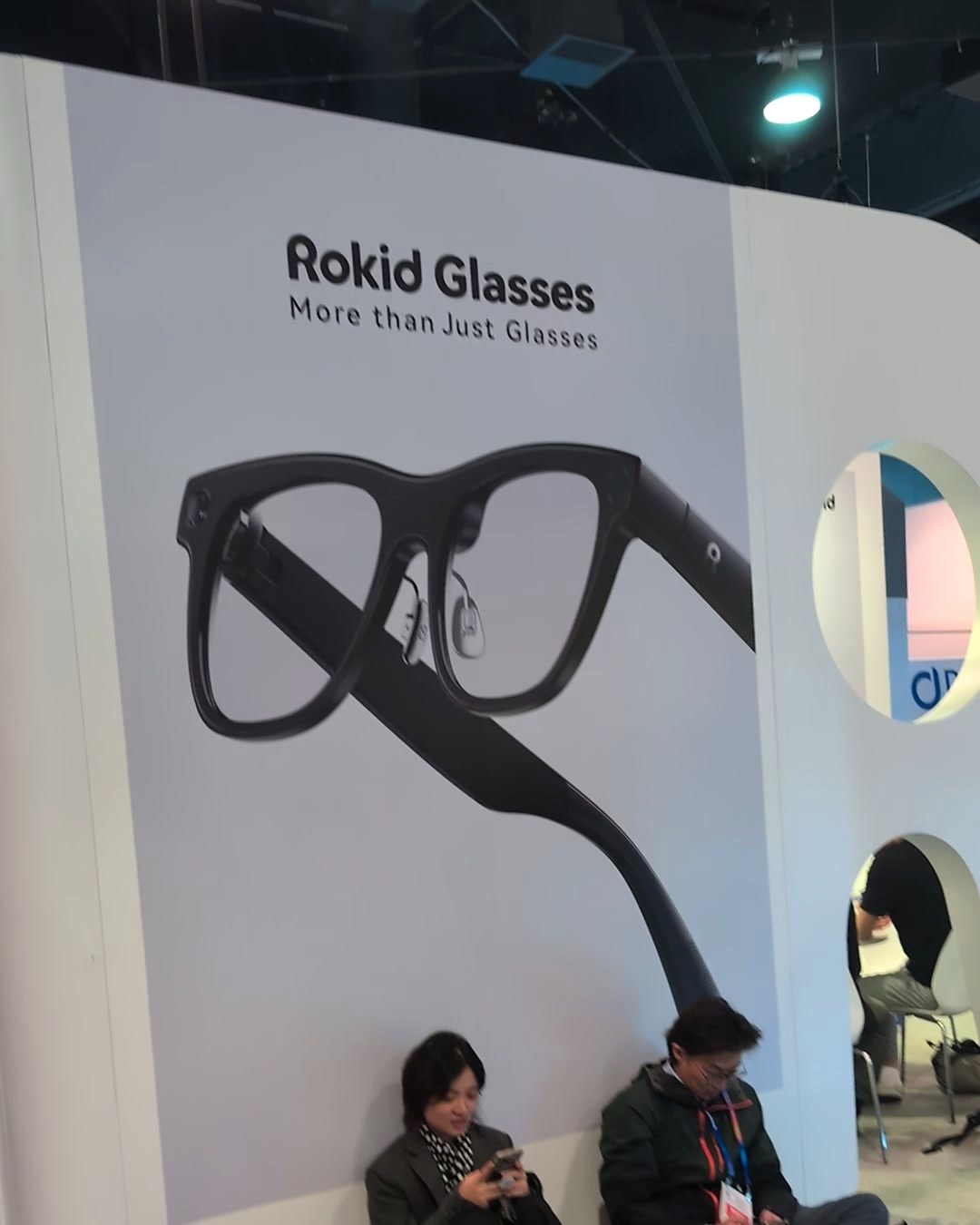
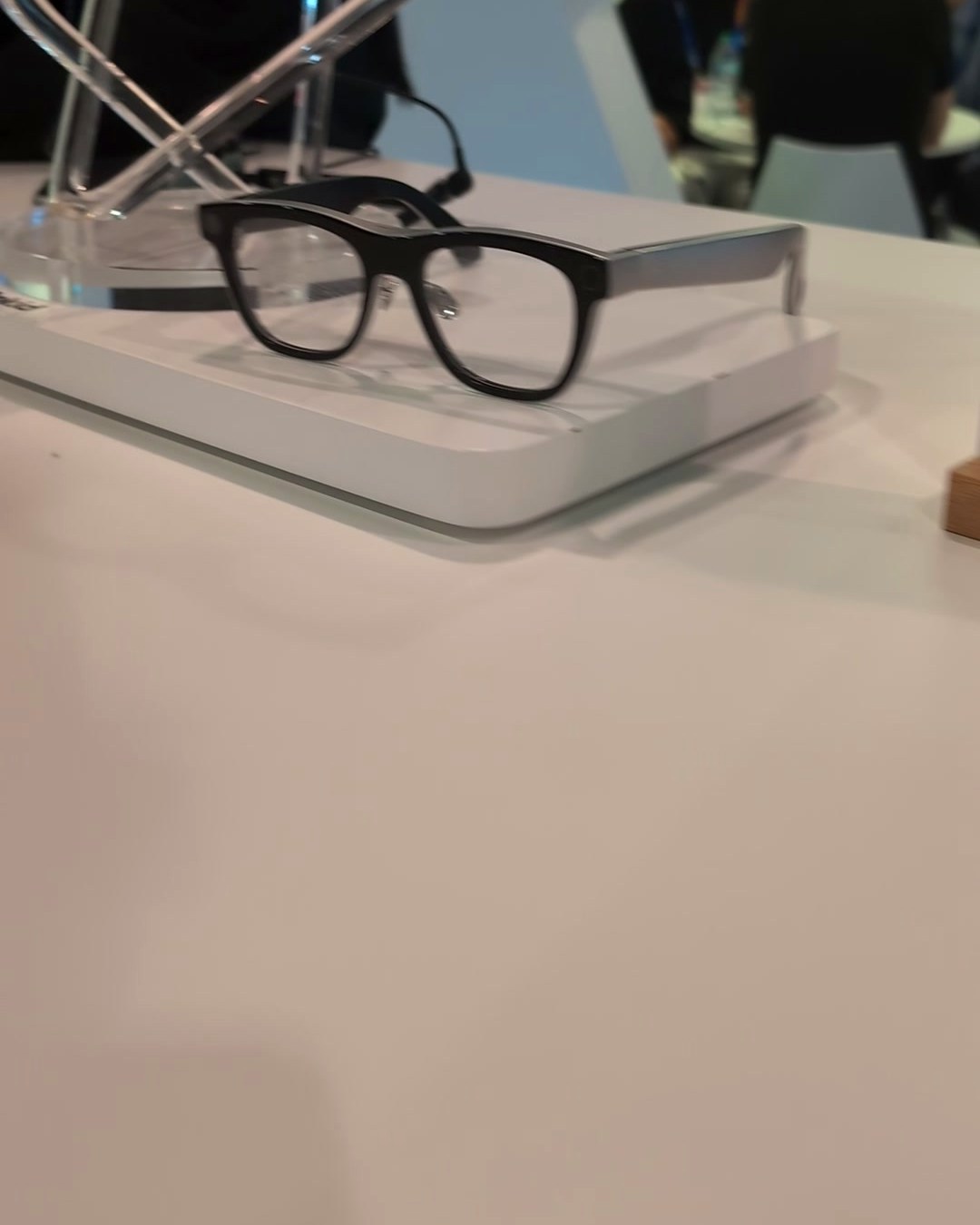
Rokid’s booth was built around one message, printed on a wall-sized graphic of a pair of black frames: “Rokid Glasses. More than Just Glasses.” On the counters, the glasses sat on clear acrylic stands, and staff walked visitors through demos while wearing the company’s tethered AR glasses, plugged into a phone.
According to Rokid’s CES announcement, it brought three things to the show. Rokid Glasses are 49-gram AI and AR glasses with real-time translation, object recognition, meeting transcription, a teleprompter and a first-person camera. The AR Spatial kit pairs Rokid Max 2 glasses with the Station 2 to put a virtual screen of up to 300 inches in front of you. The third was an enterprise tour-guide system. AR Spatial won Laptop Mag’s “Best Gaming Headset” award at the show, which listed it at $648 on pre-order.
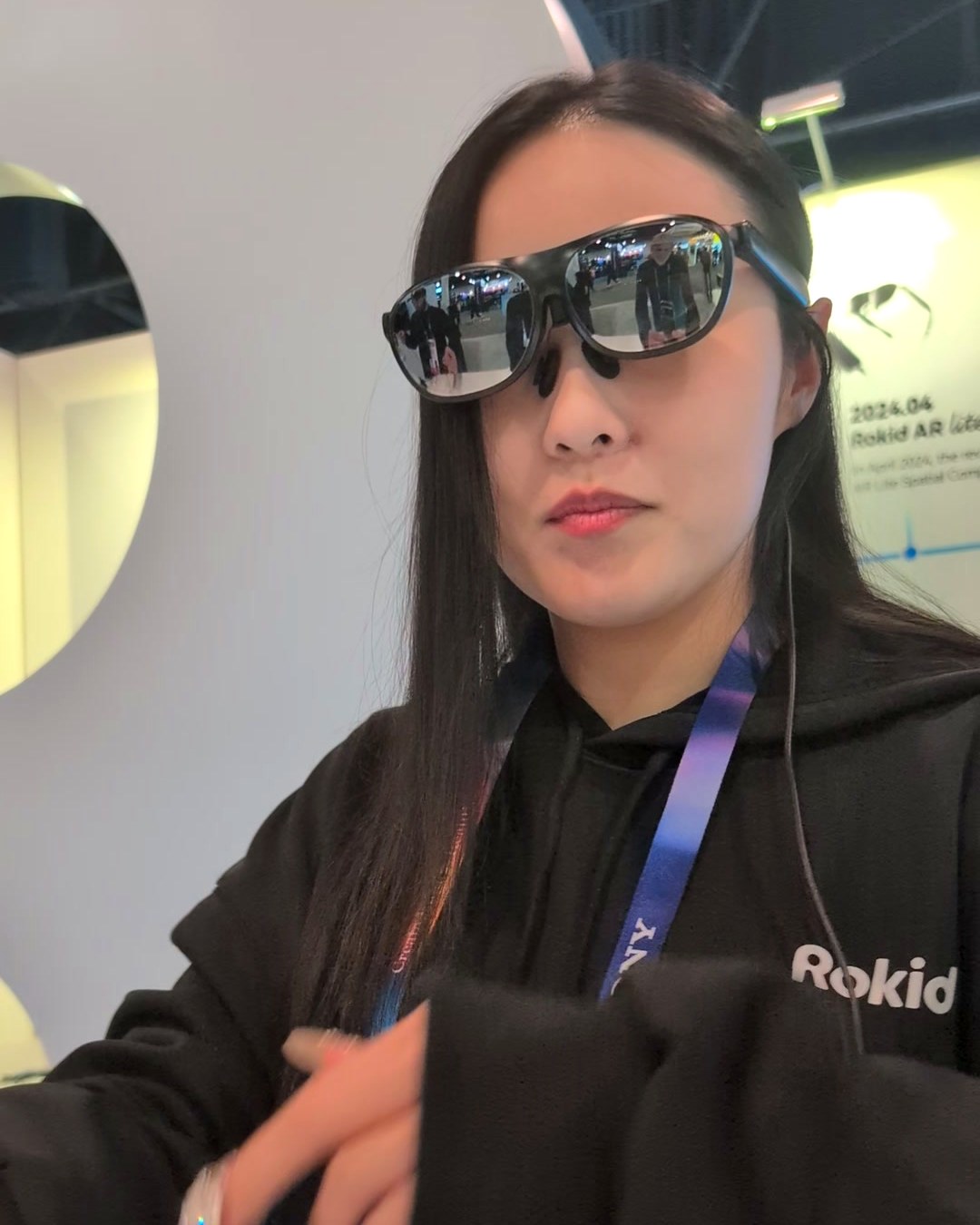
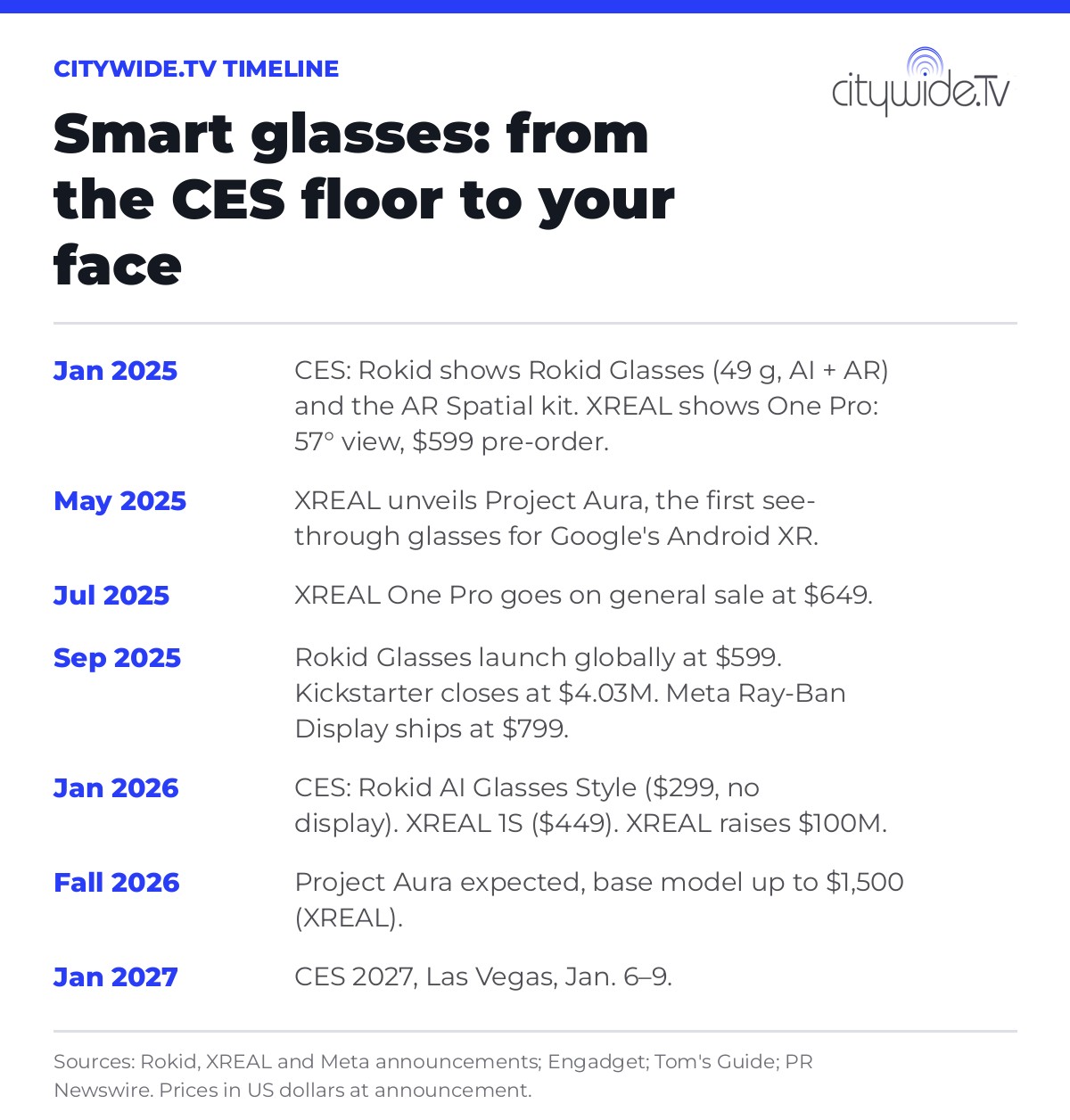
What happened next: Rokid Glasses launched worldwide at IFA in September 2025 at a retail price of $599 (Rokid), with green micro-LED displays in both lenses, a 12MP camera and translation in 89 languages. Its Kickstarter closed on November 20, 2025 with $4,028,111 from more than 5,800 backers (PR Newswire). At CES 2026, Rokid went the other direction and introduced AI Glasses Style: no display at all, 38.5 grams and $299 (Engadget). By February 2, 2026, the company said it had sold more than 15,000 of them.
XREAL: the giant glasses you couldn’t miss
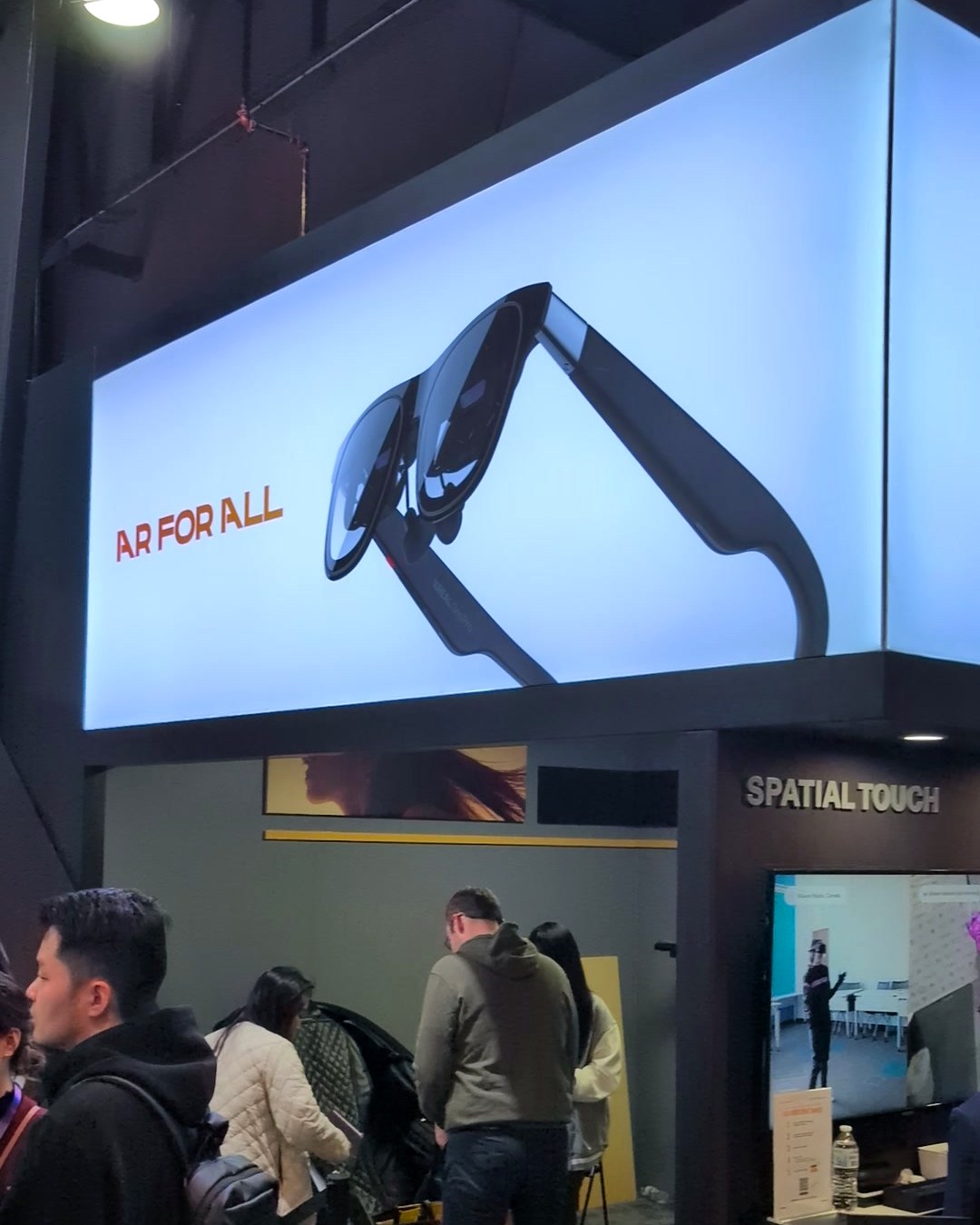
XREAL’s booth was hard to miss: an oversized pair of XREAL One glasses held up by a giant robotic hand, a performer in a patent-leather coat posing in the real thing, an “AR FOR ALL” light box, a hands-on “Spatial Touch” station and a car parked on the stand for in-car demos.
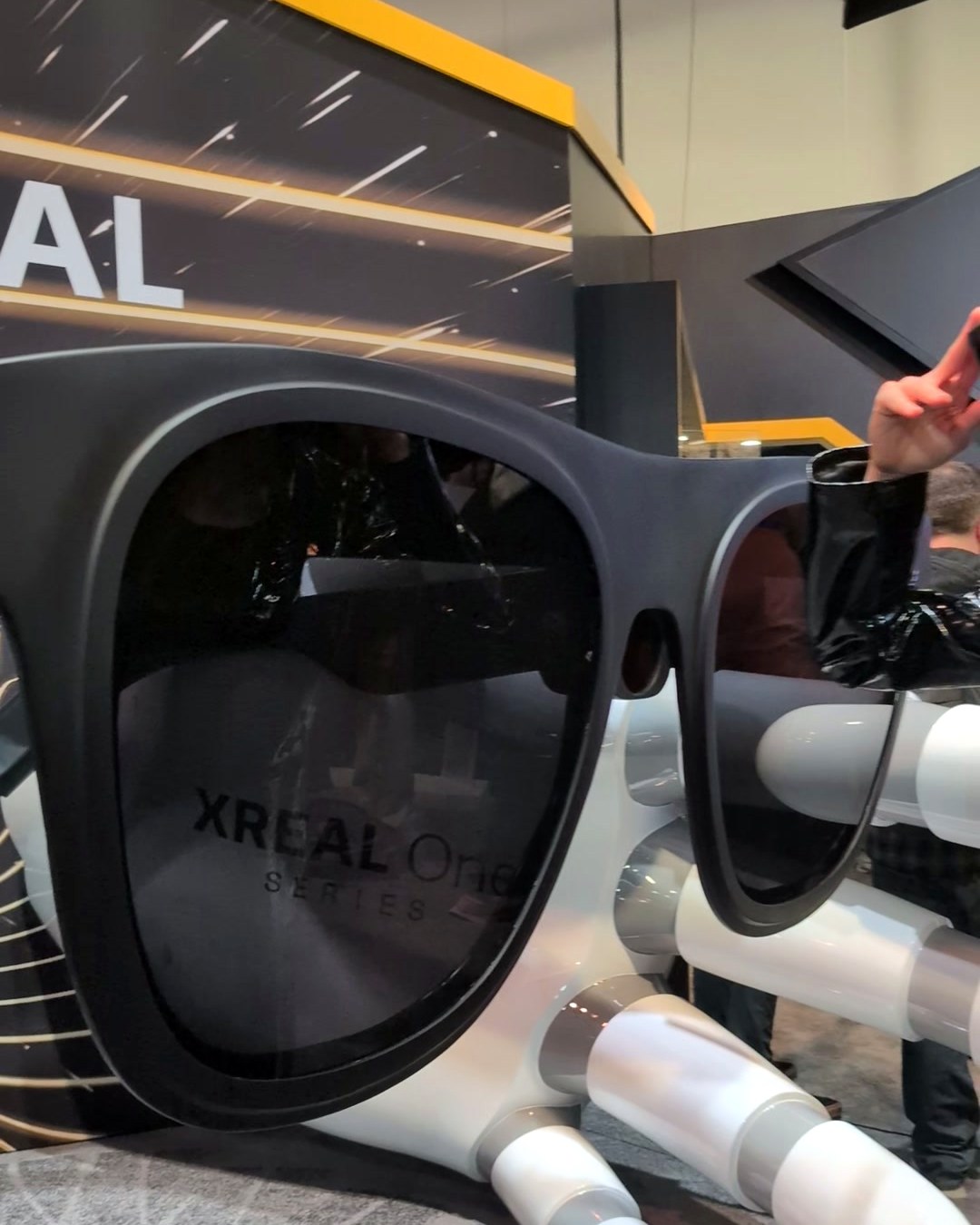
The headline product was XREAL One Pro, which the company announced on the eve of the show: a 57-degree field of view, flat-prism lenses, 87 grams, its own X1 chip and sound by Bose, for $599 on pre-order. XREAL also showed XREAL Eye, a small camera that clips onto the glasses.
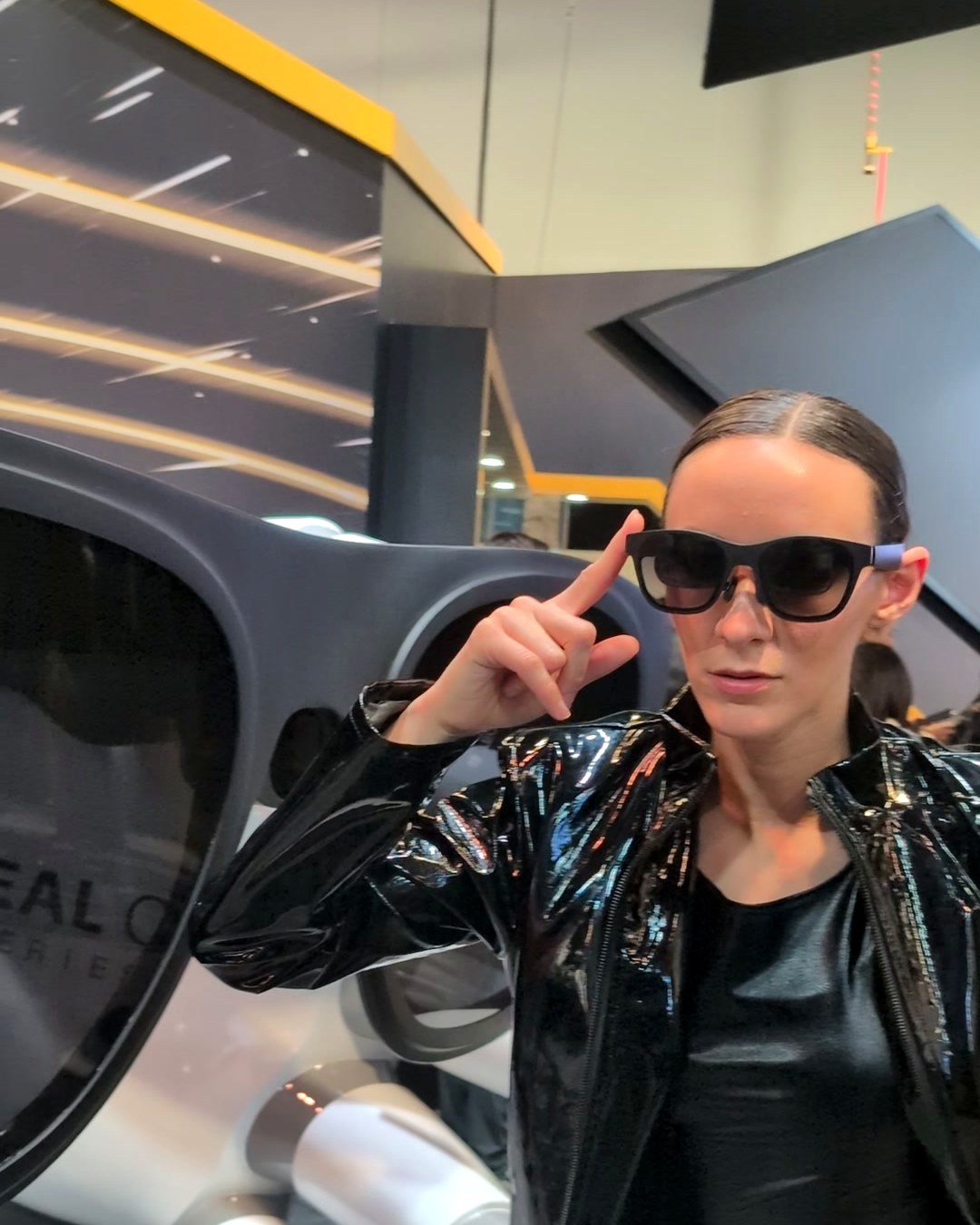
What happened next: One Pro went on general sale on July 1, 2025 at $649, with the Eye camera at $99 (XREAL). In May 2025 at Google I/O, XREAL unveiled Project Aura, the first see-through glasses built for Google’s Android XR platform (XREAL). At CES 2026 it announced the $449 XREAL 1S (Ubergizmo) and the ROG XREAL R1 gaming glasses with ASUS, and that same week raised $100 million at a $1 billion valuation (Road to VR). XREAL’s Aura page now says to expect the glasses in fall 2026, with a 70-degree field of view and a base model priced at no more than $1,500.
The bigger picture
These two weren’t alone. Meta’s Ray-Ban Display, its first glasses with a built-in screen, went on sale in the US on September 30, 2025 at $799 (Tom’s Guide). Research firm IDC projected in December 2025 that glasses shipments would grow 211% in 2025 while VR headsets fell 43%. Meta held about three-quarters of the market in the third quarter; XREAL had 2%.
What to watch at CES 2027
These are our expectations, not announcements. If Project Aura ships this fall as planned, expect Android XR glasses from several brands at CES 2027 (Jan. 6–9, Las Vegas). Expect more display-free AI glasses under $300, the way Rokid went at CES 2026, and more glasses aimed at gaming and in-car entertainment, the corner XREAL was already showing off in 2025. We’ll be back on the floor to check.
Related: CES 2027 registration is open · South Florida Tech Calendar · All Citywide.TV news. Photos were taken by Citywide.TV at CES 2025, January 2025; the timeline graphic is ours, built from the sources linked above. Logos are trademarks of their respective owners. How we report: editorial standards.